


Page 25 - kaposvar26
P. 25
The rich cultural life


                                           of Kaposvár


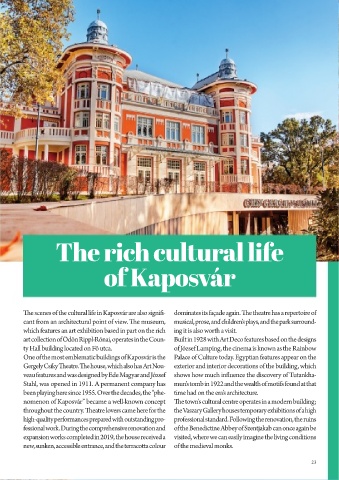
                     The scenes of the cultural life in Kaposvár are also signifi -  dominates its façade again. The theatre has a repertoire of
                     cant from an architectural point of view. Th e museum,  musical, prose, and children’s plays, and the park surround-
                     which features an art exhibition based in part on the rich  ing it is also worth a visit.
                     art collection of Ödön Rippl-Rónai, operates in the Coun-  Built in 1928 with Art Deco features based on the designs
                     ty Hall building located on Fő utca.     of József Lamping, the cinema is known as the Rainbow
                     One of the most emblematic buildings of Kaposvár is the  Palace of Culture today. Egyptian features appear on the
                     Gergely Csiky Th eatre. The house, which also has Art Nou-  exterior and interior decorations of the building, which


                     veau features and was designed by Ede Magyar and József  shows how much influence the discovery of Tutankha-
                     Stahl, was opened in 1911. A permanent company has  mun’s tomb in 1922 and the wealth of motifs found at that
                     been playing here since 1955. Over the decades, the “phe-  time had on the era’s architecture.
                     nomenon of Kaposvár” became a well-known concept  The town’s cultural centre operates in a modern building;


                     throughout the country. Theatre lovers came here for the  the Vaszary Gallery houses temporary exhibitions of a high
                     high-quality performances prepared with outstanding pro-  professional standard. Following the renovation, the ruins
                     fessional work. During the comprehensive renovation and  of the Benedictine Abbey of Szentjakab can once again be
                     expansion works completed in 2019, the house received a  visited, where we can easily imagine the living conditions
                     new, sunken, accessible entrance, and the terracott a colour  of the medieval monks.

                                                                                                   23

